Showing posts with label yard. Show all posts

Wednesday, April 25, 2012

Trees of The Little Victorian: Redbud

Eastern Redbud  
Cercis Canadensis 

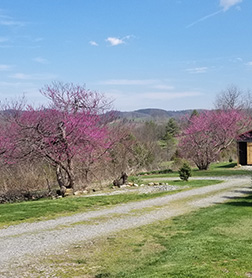
Here at the Little Victorian, the Chef cut down invasive Japanese bush honeysuckle, which weakens migrating birds with the bird-equivalent of junk food, and planted a native, Eastern redbud. We picked the redbud up on the cheap at the farmer's market, so let's hope she does well.

For eating: Like other seed pods in the legume family, seed pods of the red bud offer beneficial nutrients, such as protein, iron and complex carbohydrates, when consumed while green and tender. To prepare for eating, sauté the pods like snow peas. The flowers are also edible and can be added to salads. 

For healing: Bark and root of redbud is high in tannins and has been used as an astringent, particularly in the treatment of dysentery. 

For witching: Redbud is a traditional harbinger of spring with quite a bit of folklore around it, particularly so in the Appalachian Mountains. The term “redbud winter” refers to a cold snap that happens just as the redbuds bloom after the first blush of a few warm days in the spring. According to legend, Judas Iscariot hanged himself from a branch of the European species Cercis siliquastrum. Smaller redbud branches were also boiled to make a pink dye for homespun yarn. Redbud wood is quite strong and could be used in the making of magical tools particularly when the energy of spring-like new endeavors is desired. 
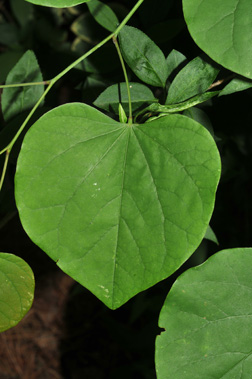
For wildlife: The Eastern Redbud is a native understory tree here in Tennessee, and birds, deer and squirrels eat the seeds. The flowers are important for the production of honey by bees.

Friday, April 20, 2012

Weed Lovin' Witchery: Yellow Wood Sorrel

The lovable lawn weed series (Purple Deadnettle, Hairy Bittercress, Plantain) continues:

Yellow Wood Sorrel
Oxalis stricta

Yellow wood sorrel is easily distinguished from clovers and black medic by its heart shaped leaves (rather than oval) and cute, five petaled flower (rather than the familiar, spiky looking clover flower). A close relative of yellow wood sorrel in the same family is commonly sold around St. Patrick’s day as shamrock.

 For eating: Tasty, sour, lemony, but not bitter. People have been eating this raw or cooked for ages. I loved the flavor of the oxalis family as a kid and still do. Good with fish or as tea or in a salad. All parts are edible. BUT it contains oxalic acid, so don’t make it the main element of your diet. (Who would? But just in case…) People who have gout, kidney problems, rheumatic conditions and any other quirky problem that reacts to oxalic acid should clearly not eat it.

For healing: High in healthy vitamin C, wood sorrel is also good for stopping bleeding, cooling fevers and soothing the stomach. It is a mild diuretic and can induce appetite in those who are sick. Use in a poultice for swelling.

For witching: Wood sorrel has a rather magical reputation. Like many herbs with healing properties, it is used in healing magic. It also associated with faeries, woodland spirits and luck.

For wildlife: Native to North America & parts of Europe & eaten by butterflies.

Friday, March 23, 2012

Weed lovin' witchery: Narrowleaf Plantain

The lovable lawn weed series (Purple Deadnettle, Hairy Bittercress) continues:

Narrowleaf Plantain
Plantago lanceolata
a.k.a. Ribwort (note the ribbed leaves)

Do you have a lawn? Do you ever see lawns? You have seen this stuff. I have seen it in diverse areas of the U.S. without ever realizing that I was standing on a goldmine of health benefits. It won’t flower until later in the season, so for now the key thing is the ribbed leaves. Also, narrow leaf and broadleaf (wider, rounder leaves, but still ribbed) plantain have the same uses. Neither is related to the starchy food plantain.

For eating: The leaves are edible stir fried or boiled and are full of good-for-you antioxidants. Young leaves are preferable especially raw in salads, but older leaves can be used after their tough, parallel veins are removed.

For healing: Crushed leaves produce an astringent, anti-toxic, antibacterial, hemostatic and anti-inflammatory juice that can be applied to cuts, insect bites and stings. It is also an expectorant, anticatarrhal and demulcent, useful as a fresh or dried tea for respiratory issues, colds and coughing. In fact, this is pretty much a miracle plant that’s good for everything. Make the tea as needed or carry it dried in a first aid kit, chew and apply to bites (or find it fresh and crush or chew). Make a vodka tincture or an oil infusion and take only 2-3 drops as needed. Make an ointment for diaper rash and hemorrhoids.

For witching: Plantain, so widely regarded as a heal-all herb, can be used for health and healing spells. Its soothing, calming, toxin-neutralizing and protective properties can be used magically as well as physically. It is especially good for taking the sting out of arguments and creating a well protected and happy home.

For wildlife: Like most garden weeds, it is not native to North America. However, birds are fond of plantain seeds, which contain a higher percentage of oil than many seeds and are grown commercially and included in some bird seed mixtures. Children sometimes play games with the long flower stalks. Children count as wildlife.

Thursday, March 1, 2012

Weed lovin' witchery: Purple Deadnettle

Lamium purpureum
Purple deadnettle
a.k.a Archangel

Purple dead nettle is popping up all over the place at this time of year, including here at the little Victorian. Aside from being cute and sporting a pretty combination of purple and green, it is both medicinal and edible.

For eating:
It doesn't have a strong flavor, but it is a superfood, packed with fiber, iron, antioxidants and vitamins. I've had it raw, but it can also be cooked. It looks pretty on a salad.

For healing: The leaves and flowers can be dried and teas can be made from the plant either fresh or dried. Purple deadnettle is a diuretic, styptic, astringent and tonic, among other things. It's leaves can be bruised and applied to cuts.

For witching: Popping up in the earliest spring-like moments, purple deadnettle is a maideny herb. In older folklore it was said to be a cheerful herb that makes the heart merry. It grows enthusiastically were groundcover is patchy or where the soil has been disturbed, pointing to a tenacious nature and the ability to make something lovely and useful out of a barren environment. It is called deadnettle, because sometimes folks mistake it for nettle, but this gentle plant has no sting. Archangel is an alternate term, coming from the time time that it blooms and the saint's feat day.

For wildlife:
Bees, helpful pollinators, enjoy it enormously.

Wednesday, February 29, 2012

Fairy house, groundcover


Things in this photo: Handmade clay fairy house, purple deadnettle, white clover and speedwell in bloom

Thursday, December 1, 2011

The Search for an Eco-Friendly Lawn Alternative


The Little Victorian’s lawn is a half-wild medley of grass, white clover, violets, wild parsley, mock strawberry, something low growing and non-tasty in the mint family, the occasional dandelion and some other sorts of plants I can’t identify. The grass is struggling in places. Everything else is fine. And by “everything else” of course I mean the aforementioned “weeds”. Before herbicides and synthetic fertilizers came on the market in the 1950s, clover was a highly desirable component in lawns. So I have been investigating how to help the weeds take over the lawn.

It’s funny how weeds get a bad rap. Mock strawberry, clover, dandelion and parsley all have medicinal and/or culinary uses. Clover and strawberry also replenish nitrogen in the soil. They don’t need watering or fertilizer or mowing (usually). But a monoculture of grass is so delicate, and useless. You can’t use it for eating (unless you are a goat) or healing. It sucks in resources like crazy—water and nutrients from the soil and then pollutes through fertilizer, gas-powered mowers and weed killer. Grass is expensive, time consuming and terrible for the environment. How could I justify maintaining a grass lawn?

Looking for advice, I explained to my dad that I hoped the “weeds” would crowd out the remaining grass because nature abhors a monoculture and I abhor mowing and watering the lawn.* Of course he thought I was kidding and suggested Roundup for my “weed problem”.

I love my dad, but Monsanto sure does have a friend in him. Water pollution and high human and animal toxicity is nothing when compared to having a perfect lawn, right?

I have since found a wide of variety of seeds that offer a healthy, eco-friendly, low-maintenance mix of plants to create a lawn alternative. Here are some options I am considering:

Hobbs & Hopkins

Earth Turf

Outside Pride

Wildflower Farm

During my winter hibernation, I am plotting out where to sow different kinds of seed. I am thinking we may end up with a hodgepodge of drought-tolerant grass, white clover, Irish moss, creeping thyme and wild flowers. And of course the current denizens-- mock strawberries, parsley, the mint-esque thing and violets are also more than welcome to stay.

*This implies that I do in fact mow and water. It would perhaps be more accurate to say that I abhor calling my neighbor who has a wee lawn maintenance business to mow. We have never watered the lawn. Or fertilized. I think about watering, and then shudder at the waste of time and natural resources. I don’t think we will ever water. Fertilizer (derived from petroleum) runoff creates unacceptable collateral damage. That which cannot live with rain and without chemical fertilizer, cannot live with us.

Tuesday, November 22, 2011

mushrooms, rain, altar

After lots of rain here in Nashville, I decided to take the opportunity to run around in the yard with Tallulah today during a break in the weather. I went to give my outdoor altar a bit of a scrubbing when I discovered this:
Wee little mushrooms growing on the altar, which is itself a perfect old stump that my husband picked up from someone's curb after a big storm in our neighborhood. I guess they are baby bracket fungi of some sort. I find them too enchanting to scrape off. I am happy to go with the green witch flow. We'll see how they fare.

Looks like there will be eight of us crowding around our dining table this thanksgiving. So grateful I married a chef!

Thursday, November 3, 2011

Fall flowers in the yard

The backyard of the Little Victorian has recently been pretending that it is springtime. With violets popping up in the lawn (and by lawn I mean hodgepodge of grass, clover, dandelions, wild strawberries, violets and other sundry groundcover):


There are also a pile of these cute magenta flowers.

And a few wild strawberries.


So to honor my ancestors on Halloween, I added some more flowers, tucked into my outdoor altar at the base of an ash tree.